
C of O, Governor's Consent, Gazette, Excision & Deeds: What They Really Mean (And How Land Is Legally Transferred in Nigeria)
Most property disputes in Nigeria do not begin with a criminal mastermind. They begin with an eager buyer who never fully understood the life cycle of land ownership or the exact legal weight of the document handed to them. With official statistics showing that only about 3% of land in Nigeria is properly titled and nearly 60% of civil litigation stems from land conflicts, blind trust in paper title is an expensive risk. Deciphering the true legal path from government acquisition to perfected title is the single most important step every buyer must master.
Rurblist team
5 mins Read
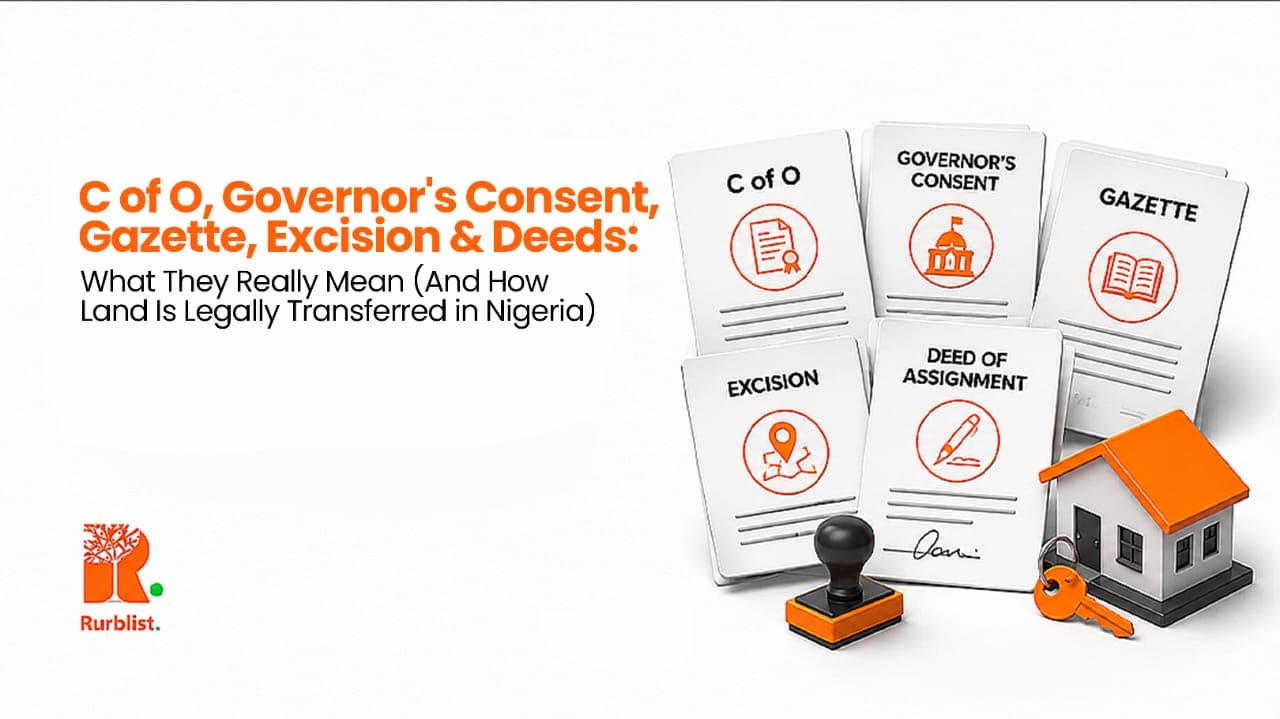
Most property disputes in Nigeria do not begin with a criminal mastermind, but rather begins with a buyer who never fully understood the the life cycle of Land Ownership in Nigeria and document they were handed.
The scale of this problem is larger than many people realize.
According to the Speaker of the House of Representatives, only about 3% of land in Nigeria is properly registered and titled. Data from the National Bureau of Statistics also found that 71.4% of landlords across Nigeria hold no formal title documents, while only 8.1% possess a Certificate of Occupancy (C of O).
The consequence appears in the courts. Studies cited by the Speaker suggest that nearly 60% of civil cases in Nigeria are land-related.
Many of these disputes could have been avoided if buyers understood one simple truth:
Not every document means the same thing, and having a document does not automatically mean the seller has a valid title.
The One Thing Every Land Buyer Must Understand First
Almost every land document in Nigeria exists because of one law:
The Land Use Act of 1978.
The Act vests all land within each state in the Governor, who holds it in trust for the people.
Rather than owning land absolutely, individuals are generally granted a Right of Occupancy, often for up to 99 years.
This means land ownership in Nigeria is really about proving your legal right to occupy and transfer land, not merely possessing a document.
Once you understand this, every other land document begins to make sense.
How Land Is Legally Transferred in Nigeria
Before explaining the documents individually, it helps to understand the journey a parcel of land typically takes. “The Life Cycle of Land Ownership in Nigeria”
Government Land
│
▼
Government releases part of it
through Excision
│
▼
Gazette published
(confirming the excision)
│
▼
Community/Family now has legal interest
│
▼
Land allocated or sold
│
▼
Deed of Assignment transfers ownership
between parties
│
▼
Buyer perfects title through
Governor's Consent
(or obtains a C of O where applicable)
Not every property follows this exact path, but most legitimate transactions fit somewhere within this chain.
Understanding where your property sits in this journey is one of the most important parts of due diligence.
Excision
An excision is the formal process through which the government releases part of a larger area of acquired land back to indigenous communities or families.
This does not mean the land is automatically safe to buy.
The excision must be officially recognized and documented.
Gazette
A Gazette is the government's official publication showing that an excision has been approved.
Think of it as the government's public announcement saying,
"This specific portion of land is no longer under government acquisition."
Without a Gazette, a seller may claim that land has been excised without any official evidence.
Even then, buyers should verify that:
- the survey actually falls inside the excised portion,
- the Gazette is authentic and
- no later government acquisition affects the land.
A Gazette is therefore evidence of an approved excision—not proof that every plot within that community is automatically safe.
Deed of Assignment
A Deed of Assignment is the legal agreement that transfers an existing interest in land from one party (the assignor) to another (the assignee).
Its most important role is not merely to prove ownership.
It should also establish the root of title; the history showing how the seller legally acquired the property.
For example, it should answer questions like:
- Was the land originally excised?
- Is there a Gazette?
- Was it inherited through Probate or Assent?
- Was it previously transferred through another Deed?
- Was it covered by a Certificate of Occupancy?
- A Deed is only as strong as the history behind it.
Certificate of Occupancy (C of O)
A C of O confirms that the government recognizes the holder's right of occupancy over a specific parcel of land.
However,
A fake C of O is still fake.
Always verify it with the state land registry.
Never rely on scanned copies alone.
Governor's Consent
Since the Governor holds the legal title under the Land Use Act, every subsequent transfer of land covered by a C of O requires the Governor's approval.
This approval is called Governor's Consent.
Without it:
the Deed may exist,
payment may have been completed,
possession may have changed,
yet the transfer may still be legally defective because it has not been perfected.
Governor's Consent is therefore less about buying land and more about legally completing the transfer.
Freehold
A freehold interest generally refers to ownership that is not limited by a fixed lease period and can be transferred or inherited indefinitely, subject to applicable laws.
However, in Nigeria, the Land Use Act significantly limits the practical meaning of "freehold."
Someone may genuinely hold a freehold interest, but buyers should still investigate:
family disputes,
pending litigation,
government acquisition,
overlapping surveys,
multiple sales,
and the property's chain of ownership.
Freehold is not the same thing as risk-free.
The Biggest Mistake Buyers Make
Most buyers are more concerned of a property has C of O.
A better concern should be,
"Can the seller prove an unbroken chain of ownership from the original title to today?"
That single question often reveals more than the document itself.
Where Rurblist Fits
At Rurblist, we believe buying property should not require guessing what a title document means.
Our verification process goes beyond collecting copies of documents. We verify the chain of ownership, review title documents, examine survey information, check for government acquisition where applicable, and work with legal professionals to help buyers understand exactly what they are purchasing before committing funds.
Stay tuned for more updates on the Nigerian Real Estate Market.
Keep Reading
 Articles
How Infrastructure Projects Quietly Double Property Values
Sub-Saharan Africa requires an annual infrastructure investment of 7.1 percent of GDP to meet expanding urban demand, exposing a massive capital gap that early real estate investors are positioned to exploit. Value appreciation rarely happens overnight; it builds quietly along new rail lines, highway expansions, and port corridors long before the average buyer notices. With Nigeria embarking on one of its largest transport infrastructure pushes in modern history—backed by a ₦3.23 trillion roads budget in 2026—understanding how infrastructure reduces friction and drives demand is the key to unlocking long-term property wealth.
Oct 30, 2026 | 3 min Read

Property Verification in Nigeria: How Rurblist Helps Property Investors Buy With Confidence
Nigeria's property market has become one of the most consistently profitable spaces for fraudsters in the country, and the numbers back that up more clearly than the anecdotes do.
Get one Real Estate post every week
Verification insights and location guides, sent when we actually have something worth saying.