
Property Verification in Nigeria: How Rurblist Helps Property Investors Buy With Confidence
Nigeria's property market has become one of the most consistently profitable spaces for fraudsters in the country, and the numbers back that up more clearly than the anecdotes do.
Rurblist team
Property Verification in Nigeria: How Rurblist Helps property investors buy with confidence.
Nigeria’s property market has become one of the most consistently profitable spaces for fraudsters in the country, and the numbers back that up more clearly than the anecdotes do.
In a single year, the Economic and Financial Crimes Commission recorded 444 real estate fraud cases nationwide, with losses exceeding ₦10 billion, and the Nigerian Institution of Estate Surveyors and Valuers has found that real estate scams account for roughly 20 percent of all property related disputes across the country. The Nigerian Police Force’s FCT Command alone reported 50 real estate fraud cases in 2022, with losses totaling billions of naira. (The Africanvestor)
Lagos carries a disproportionate share of this. One study found that 42 percent of property disputes in Lagos in a single year involved fraudulent transactions. Separately, Lagos alone has logged more than 1,500 real estate fraud cases since 2020, and property scams are estimated to cost the Nigerian economy roughly 4 billion dollars a year.
Between January and July 2025 alone, estimated losses to real estate scams across the country reached ₦16.2 billion, with Lagos accounting for the largest share simply because of its size as the commercial capital.
Some of the more detailed reporting puts the scale even higher. One analysis found that Lagos and Ogun states combined record over 500,000 land scam incidents every year, and that up to 95 percent of land titles in these markets face some risk of contestation.
The specific figures vary depending on who is measuring and how, but the direction they all point in is the same. This is not a fringe problem affecting a few unlucky buyers. It is a structural weakness sitting underneath one of the largest asset classes in the country.
Where the fraud actually happens
The most common patterns include fake title documents, the same plot sold to multiple buyers, developers who collect deposits and disappear, land quietly sold despite being under government acquisition, boundaries misrepresented to inflate size, construction abandoned midway, and people impersonating developers who do not actually exist. Every one of these patterns shares a common thread. They all succeed because verification either did not happen, or happened too late, usually after money had already changed hands.
What buyers have been left to do about it
For years, the only real defense available to a buyer was hiring an independent lawyer to manually check a title, physically visiting a land registry, and hoping that registry’s records were accurate and up to date. This works, when it happens properly, but it depends entirely on the buyer knowing to do it, having the resources to pay for it, and having the patience to wait for it. Diaspora buyers in particular are often left with no realistic way to do any of this from thousands of kilometers away. Some newer legal technology platforms have started digitizing parts of this process, but for most buyers in Nigeria today, verification still means finding a lawyer you trust and hoping the registry they check is complete.
This is exactly the gap Rurblist was built to close
Rurblist does not treat verification as an optional extra a buyer has to arrange for themselves. It is a formal legal process built into every transaction on the platform, before a sale can close, not after a problem surfaces.
Here is exactly how it works.
Step one: verification begins the moment escrow starts
Once a buyer and seller agree on key transaction terms, the buyer initiates escrow through Rurblist’s appointed escrow agent; FCMB TRUSTEES, licensed and regulated by the Securities and Exchange Commission (SEC). This immediately triggers a verification request to Rurblist’s Legal Team, rather than leaving verification as a separate step the buyer has to remember to arrange.
Step two: a local Node Lawyer is assigned
The Legal Team assigns the case to the Rurblist Node Lawyer closest to the property’s location, someone who understands the specific registry, the specific local risks, and the specific history of disputes in that area, rather than a generalist reviewing documents from a different state.
Step three: a formal checklist, not a quick glance
The assigned lawyer works through Rurblist’s Property Verification Checklist, covering five specific areas: confirming the identity of the property owner, verifying ownership documents against government records, conducting land registry searches, reviewing survey plans and title documents, and identifying any encumbrances, disputes, or government acquisition issues. A physical inspection happens where required.
Step four: a clear, documented outcome
The lawyer submits a formal verification report to the Head of Legal, who issues one of three outcomes: Verified, Verified with observations, or Verification failed. This result appears directly inside the buyer’s transaction dashboard, removing the ambiguity that usually surrounds this stage of a property purchase.
Step five: your money stays protected the entire time
Because verification runs alongside escrow rather than before it, funds are never sitting exposed while this review happens. If a buyer isn’t satisfied with a property’s legal status after reviewing the verification documents, the money is returned, with only Rurblist’s service fee retained.
The only secure way to acquire properties is to go through the standard and legal procedures of property verification. Rurblist helps you cross that bridge with ease.
Protect your property transactions with RURBLIST
Keep Reading
 Articles
How Infrastructure Projects Quietly Double Property Values
Sub-Saharan Africa requires an annual infrastructure investment of 7.1 percent of GDP to meet expanding urban demand, exposing a massive capital gap that early real estate investors are positioned to exploit. Value appreciation rarely happens overnight; it builds quietly along new rail lines, highway expansions, and port corridors long before the average buyer notices. With Nigeria embarking on one of its largest transport infrastructure pushes in modern history—backed by a ₦3.23 trillion roads budget in 2026—understanding how infrastructure reduces friction and drives demand is the key to unlocking long-term property wealth.
Oct 30, 2026 | 3 min Read
 Articles
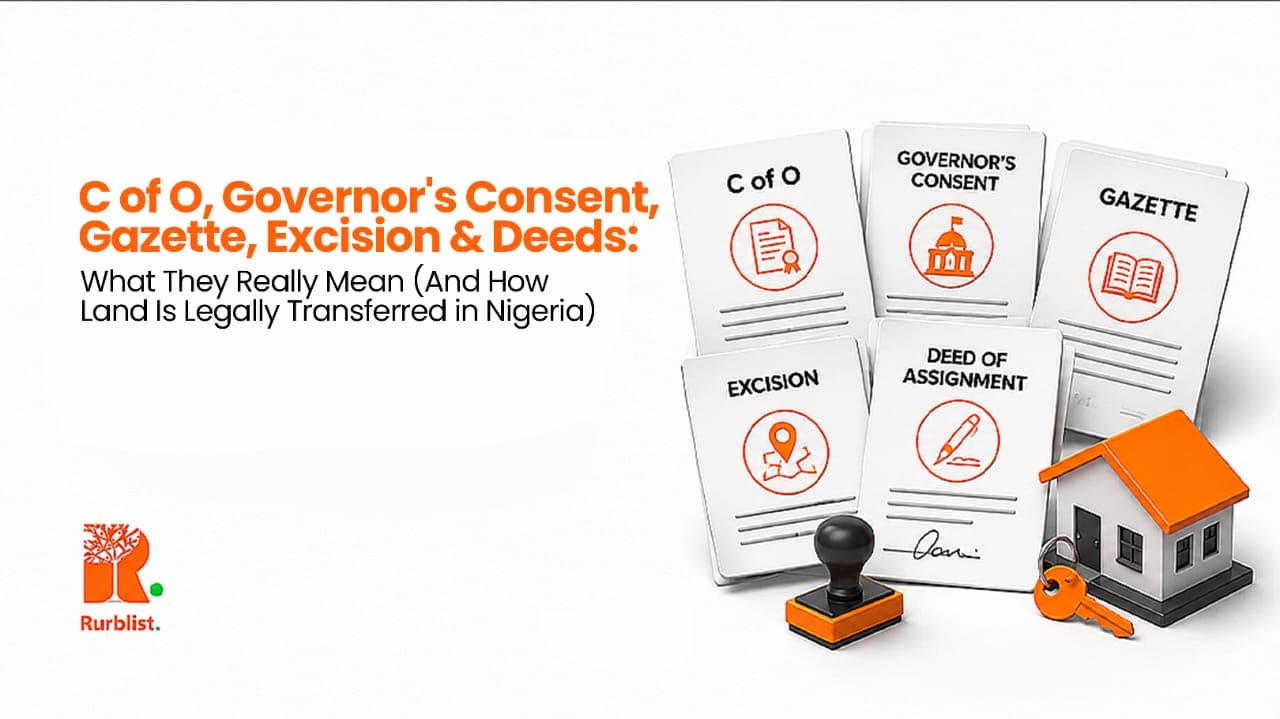
C of O, Governor's Consent, Gazette, Excision & Deeds: What They Really Mean (And How Land Is Legally Transferred in Nigeria)
Only 8.1% of Nigerian landlords hold a C of O, and nearly 60% of civil court cases are land-related. Understand the life cycle of land ownership, decipher key title documents, and learn why unbroken chain of title matters more than paper promises.
5 mins Read
Get one Real Estate post every week
Verification insights and location guides, sent when we actually have something worth saying.